
Fire sprinklers are a fixture in most commercial and multi-family buildings, and in many cases are required by law. Unfortunately, the assumptions most people hold about how they work and what they can do are frequently wrong. That disconnect matters, because misunderstanding your sprinkler system is one of the easiest ways to end up with one that fails when you need it most.
In our last post, we covered some of the most persistent myths about fire sprinklers and how they stack up against reality. In this post, we’re going a level deeper — into how sprinklers work mechanically, what they’re actually designed to do, and what you can do to make sure your system performs when it matters most.
Types of sprinkler systems
Before we talk about how sprinkler systems work, it’s important to define what kinds of systems we’re talking about. There are four main types:
- Wet pipe systems — The most common type by far, and the oldest. Water is already present in the pipes under pressure, right up to the sprinkler head. When a head is triggered, water flows immediately.
- Dry pipe systems — The second most common type, used primarily in spaces where pipes could freeze, like parking garages or unheated attic areas. Instead of water, the pipes are filled with pressurized air or nitrogen. When a head triggers, the pressure drops and a valve releases water into the pipes.
- Pre-action systems — A more specialized system that can be customized to require two separate events to occur before water is released, typically a smoke or heat detector activating in addition to a sprinkler head triggering. These are common in data centers and other environments where an accidental discharge would be catastrophic.
- Deluge systems — Unlike standard sprinklers, deluge heads are always open. Water is held back by a valve and released all at once when triggered by a separate detection system. These are typically reserved for high-hazard environments like chemical storage areas, aircraft hangars, and fueling stations.
How do wet and dry sprinklers work?
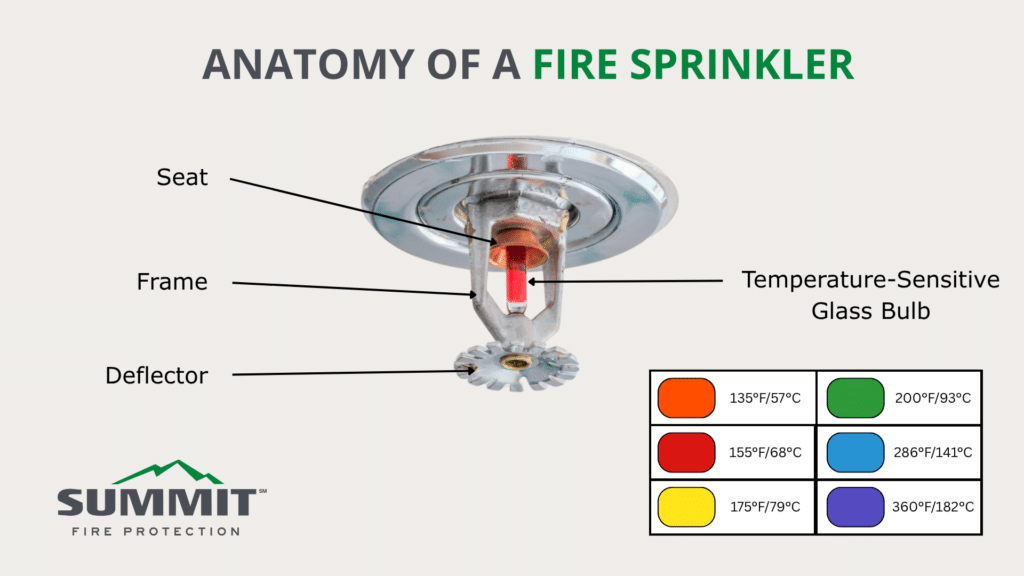
Wet and dry systems make up the overwhelming majority of sprinkler systems found in the US, so let’s take a look at how they work. Both systems have a network of pipes with sprinkler heads attached. Each sprinkler head contains a small glass bulb filled with a glycerin-based liquid. As heat rises from a fire, that liquid expands until the pressure shatters the bulb.
This is where wet and dry systems differ:
- In a wet system, water is already in the pipes and ready to spray — the bulb shattering simply releases the plug that was holding water back.
- For dry systems, the pipes are filled with pressurized air or nitrogen. When the bulb shatters, the pressure drops in the pipes, which then triggers a valve to open, filling the pipes with water.
The water then hits a deflector plate at the endof the head and sprays outward in a specific pattern designed to cover the area below.
Design considerations
The basics of how sprinkler heads operate is the same, but there are a number of details that are extremely important when designing a sprinkler system. Two key features are the type of trigger used, and the size of the opening at the base of the sprinkler head, known as the orifice.
- The trigger affects the reaction temperature and time. The color of the bulb indicates the temperature at which it will activate — for example, red bulbs are rated at 155°F, while higher-temperature bulbs in deeper orange or yellow are used in environments that run naturally hot. The diameter of the bulb affects response time: a thinner, 3mm bulb reacts faster and is classified as “quick response,” while thicker 5mm and 7mm bulbs take longer to activate. There are also “soldered link” triggers where the activation temperature is identified by different colored factory-painted frame-arms. The most common activation temperatures are: Unpainted = 165°, White = 212°, and Blue = 280°.
- The orifice: the opening where the head connects to the pipe — determines how much water can flow through. Larger orifices deliver higher volumes of water and are used in higher-hazard applications where more aggressive suppression is needed.
So, while every sprinkler head might look similar at a glance, each one is carefully chosen for its specific environment. Which brings us to the next question: once a sprinkler activates, what is it actually trying to accomplish?
What are fire sprinklers designed to do?
The assumption is that sprinklers are meant to extinguish fires completely. In reality, their designed purpose is more specific than that, and understanding the distinction is important.
The fire protection industry uses four key terms to describe what a system can do to a fire:
- Control — Maintaining a steady heat release rate, preventing the fire from growing any larger.
- Suppress — Achieving a decreasing heat release rate, actively reducing the fire’s intensity.
- Confine — Keeping the fire contained to a specific area, preventing it from spreading.
- Extinguish — Putting the fire out entirely.
Standard sprinkler systems — the kind you’ll find in most commercial and residential buildings — are designed and tested to the benchmark of control. The primary objective of a sprinkler system is to give occupants time to evacuate safely and to keep the fire from spreading until the fire department arrives. Complete extinguishment is the fire department’s job.
That said, sprinklers frequently do more than they’re designed to do. In many cases, the fire is fully extinguished before firefighters ever arrive. But when a sprinkler successfully contains a fire to a single room and keeps it from spreading, it has done exactly what it was built to do.
And by that measure, it turns out sprinklers do their job remarkably well.
The numbers that tell the real story
When effectiveness is measured by this benchmark, sprinkler systems are exceptionally reliable. According to a report by the NFPA, from 2017 to 2021, sprinklers operated in 92% of fires large enough to activate them, and were effective at controlling the fire in 97% of those incidents.
The impact on life safety is even more striking. The same NFPA report notes that the civilian injury rate per 1,000 reported fires is 90% lower in properties with sprinklers than in those without. That’s a huge reduction of risk for building occupants when systems are in place and functioning properly.
So what accounts for the cases where sprinklers fall short? That brings us to one of the most important aspects of sprinkler system performance.
When sprinklers fall short, it’s usually a human problem
According to NFPA data, when sprinkler systems fail, it’s almost always the result of human error in design, installation, maintenance, or operation — not a mechanical defect. We can group these failures into three broad categories:
- The single most common reason sprinklers fail to operate is also the most preventable: the system was simply turned off. This accounts for 63% of all sprinkler failures. A valve gets closed during a maintenance visit or inspection, and nobody turns it back on. Or a monitoring alarm goes off and gets silenced without anyone investigating why. The water never makes it to the heads, and a perfectly serviceable sprinkler system never gets to do its job.
- Another significant cause is deferred or inadequate maintenance. Sprinkler systems have moving parts and metal components that are exposed to water over long periods of time. Corrosion builds up. Components degrade. Heads get painted over or physically damaged. None of these issues will show up as a problem until a fire breaks out — unless someone is regularly inspecting the system and addressing what they find.
- A third cause of failure is a system that wasn’t designed correctly for its environment. Fire hazards vary enormously between a high-rise apartment building, a cold storage warehouse, and an ethanol plant. Each requires a different system design, different head types, and different water flow calculations.
The bottom line: when sprinklers fail, it’s almost never because the technology doesn’t work. It’s because the system wasn’t maintained, wasn’t monitored, or wasn’t designed correctly for the space it’s protecting.
A system that works, when you work with it
Fire sprinklers aren’t magic, and they’re not designed to be a complete substitute for the fire department. What they are is an extraordinarily effective first line of defense that buys time, saves lives, and limits damage in the critical minutes before help arrives. Even when they don’t fully extinguish a fire, they’re doing exactly what they were designed to do.
But that performance doesn’t happen automatically. It requires the right system for the right environment, installed correctly, inspected regularly, and monitored properly. When all of those pieces are in place, the numbers speak for themselves.
Summit Fire Protection has extensive experience designing, installing, inspecting, and maintaining sprinkler systems of all types, from wet and dry systems in residential and commercial buildings to complex pre-action and deluge systems in industrial environments. Whether you’re building new, upgrading an existing system, or just trying to make sure what you have is ready when you need it, our team is here to help.