
Fire Prevention Week runs October 4 to 10 this year, and it’s a great time for facility and operations managers to pull the fire safety program out, take a close look at it, and make sure it’s ready for whatever the next twelve months bring.
Building a program that’s ready when it’s needed comes down to a handful of concrete pieces, plus a commitment to keeping those pieces current.
What Belongs in a Fire Safety Program
At the center of any fire safety program is the emergency plan: the document that spells out evacuation routes, assembly points, and who’s responsible for what when an alarm goes off. On its own, though, a plan is just paper. It only works if employees actually know their role in it, if that knowledge has been tested under something close to real conditions, and if the people expected to act have the specific training to do so. That’s three distinct jobs, not one.
Assigning Employee Roles
A plan that says “evacuate the building” doesn’t tell anyone what to actually do in the first sixty seconds. Someone needs to take headcount at the assembly point. Someone needs to check the restrooms and any areas with limited visibility on the way out. In an industrial or warehouse setting, someone may need to shut down a specific piece of equipment or close off a hazardous process before they leave, which means that role has to go to a person who’s actually trained to do it safely, not whoever happens to be closest.
Roles need names attached to them, not just job titles, and every role needs a backup. Facilities running multiple shifts should assign roles separately for each shift; the person responsible for headcount on days is very likely not on-site when the night crew is working, and an unassigned role at 2 a.m. is the same as no plan at all.
Evacuation Drills
A drill is the only way to find out whether the plan and the assigned roles actually work outside of a document. It’s common for a facility to run one pre-announced drill a year during the day shift and call it done. That tells you very little about what happens with a full facility on a Tuesday afternoon, let alone a skeleton crew running the plant overnight.
A stronger approach runs drills across shifts on a rotating basis, so the plan gets tested under the conditions your people actually work in, not just the easiest one. New employees should walk through an orientation on the evacuation plan and their nearest exits in their first few days on the job, rather than waiting for the next scheduled drill to find out where they’re supposed to go. After each drill, take a few minutes to debrief: where did people bunch up, did the assigned roles get carried out, how long did headcount actually take.
Extinguisher Training
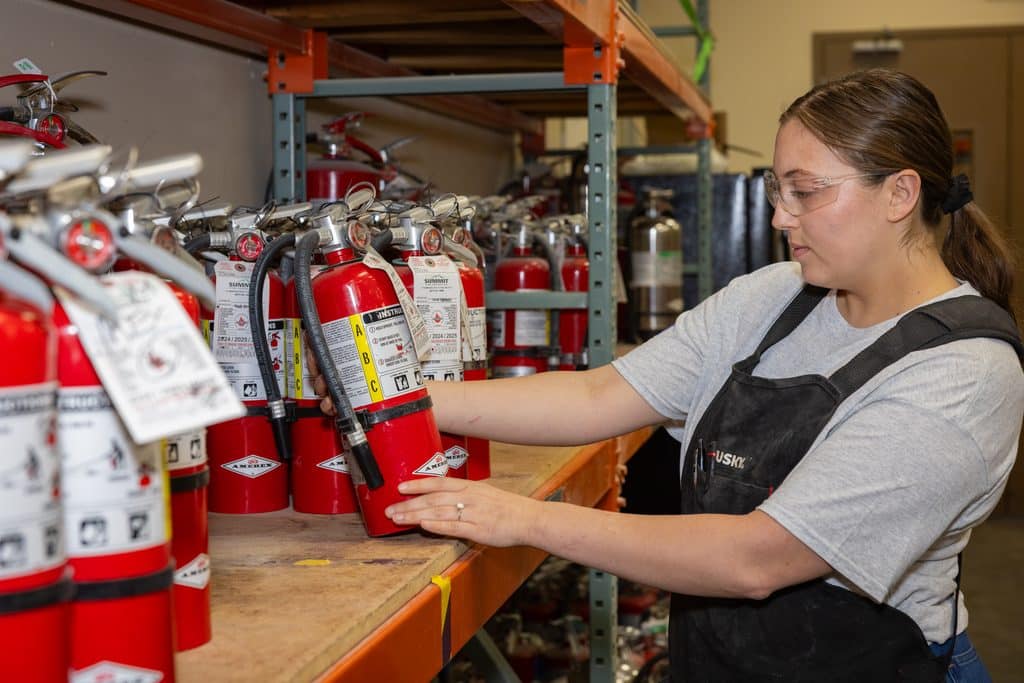
Fire extinguishers are for small, contained fires in their earliest stage, and any employee who might reach for one needs to understand that line clearly. If a fire is spreading, producing heavy smoke, or there’s any doubt about whether it can be handled safely, the right call is to evacuate and let the fire department handle it, not to keep fighting it.
For facilities with a commercial cooking operation, extinguisher training needs a second layer. Grease fires require a Class K extinguisher, not the standard ABC extinguisher mounted in the hallway, and if a kitchen’s suppression system has ever discharged, a call to a fire protection professional afterward isn’t optional as the system must be reset before cooking operations can resume. Often, once the suppression system discharges, residual heat can remain in the grease/oil and can cause reignition of the fire. The K Class is designed to be used, only after the Suppression system has been activated, if reignition occurs. Its situations like this, where it is important to have the properly rated Fire Extinguishers in the correct places.
Getting the roles, the drills, and the training right depends on a plan that’s actually current. A plan written three years ago for a workforce that’s turned over twice, in a building that’s added a new production line since, isn’t going to be as effective as it needs to be. Put a refresh of the emergency plan itself on a recurring schedule so the roles, routes, and equipment it references match what’s actually on the floor.
“Charge Into Fire Safety: Safe Charging Is a Superpower”

This year’s Fire Prevention Week theme, announced by the National Fire Protection Association, is “Charge Into Fire Safety: Safe Charging Is a Superpower,” and it’s the second year running that the campaign has centered on lithium-ion battery safety. That’s a reflection of how common these batteries have become. The hazard they present is different from an ordinary combustible fire, because the battery itself is both the fuel and the ignition source. That makes it harder to detect early and harder to suppress from the outside.
This is worth building into your program alongside the rest of it. A few practices make a real difference:
- Use only chargers that are listed for the specific device or equipment being charged, since mismatched or unlisted chargers are a common cause of overcharging and the electrical failures that lead to thermal runaway.
- Designate specific charging locations, away from exits and walkways, so a battery event doesn’t block an evacuation route.
- If a battery is visibly swollen, damaged, or unusually hot, immediately stop using it.
Keep the Program Running Past October
Fire Prevention Week is a good annual trigger, a reason to check that your plan is up to date. But the actual work of a fire safety program happens on the other fifty-one weeks, in the routine of keeping the plan current and making sure every employee, on every shift, knows their part in it.
Summit Fire Protection works with facility and operations managers across the Midwest, Colorado, and Arizona to keep more than just equipment in shape. If it’s been a while since your program got a real look, contact Summit Fire Protection to get started.