In honor of Women in Construction Week (March 1-7, 2026), we spoke with women currently working with Summit Fire Protection to learn more about their career paths in fire and life safety, the support that helped shape their journeys, and what it’s like working in this essential field.

Tanya Rice is the lead designer for the rack division in St. Paul, MN. Tanya designs project sand over sees new designers and projects for a team of 10. Tanya specializes in niche fire protection systems protecting high-rise rack storage facilities, generally with automated and robotic systems.
“In my 30 years working with Tanya, I have seen her tackle our most challenging projects with precision and grit,” shared Sean Merkel, Rack Storage Department Manager. “I can truly say that she is the fire that helps drive our well-oiled machine. I am proud of her and her many achievements.”
Read on as Tanya shares her journey into the fire and life safety industry.
First of all, what are rack systems?
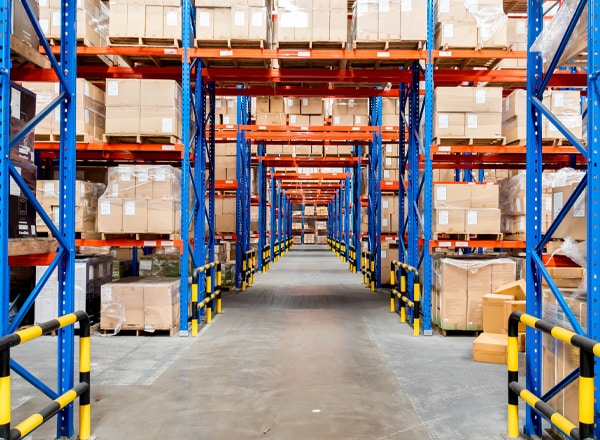
When you think about standard rack storage you think about what you see in a big warehouse store where you have racks where there are pallets of products in the aisles and you can choose the product you are shopping for. You may notice there is a pallet that’s above on a shelf that hasn’t been unwrapped and then there might be a pallet above it as well. That would be what we would call standard pallet racking, and it’s loaded with a pallet jack, or with a one-man pallet lift.
In an automated rack storage system, it’s all done with robotics, and there might be 15 cars moving in an aisle, and the aisle is literally only wide enough for the car. There are no people in the facility. It is purely run by robotics conveyors and mechanical arms. Yet there are vehicles moving at all times. They might be moving horizontally; or they might be moving horizontally and vertically. They’re moving through these aisles. They might be automated cranes. There are multiple different ways, but there’s no people in the facility. It is purely automation, conveyors and robotics.
How did you get started in fire and life safety?
I’ve been working in rack storage for 32 years. I got started in fire protection because the company that I worked for previously was owned by my father, United Sprinkler, and that’s what he did was rack storage. When Summit acquired us, the rack division was moved to Summit Fire Protection.
Because of my dad’s background in fire protection, it was born and bred in our family. Growing up, I had gone to school to be an actuarial and while I was waiting to do my interviews, my dad suggested that I come to work for him while I waited. I have been here for 32 years.
I am a designer now but have filled several different roles at one time or another. I do spend a good deal of time doing surveys in the field and/or observing when testing and job completion is happening. Sometimes I meet with the city and the insurance company and explain what our design is going to be, educating all involved on what the need for the proper level of fire protection would be.
What has kept you working in the fire protection industry?
It’s a need-based business. There will always be a need for fire protection to keep people and property safe. But there’s also something to be said for being able to watch your design come to life in the field. Going from a sketch on a piece of paper, to a drawing, to communicating the plan with an installer or an owner, to being able to see the actual system is extremely satisfying. All of a sudden you have this building with fire protection in it, that was something you thought about on a napkin a long while back.
What kind of special thought needs to be considered regarding rack storage systems for fire protection design?
Quite literally, it is much more specific, down to the millimeter. When you’re working in a warehouse, an apartment building, a hotel, or a grocery store, if your sprinkler is off by half an inch, it is not a big deal. However, if you’re working on a robotic system on a rack, where the machine is moving at 60 miles an hour, if you are off by half an inch, you’re going to get hit.
What training was necessary for the designer role?
I am NICET IV certified, and I hold a few other required state licenses. There are four levels to NICET. NICET I is the entry level—you can get within the first two years in the industry. NICET II is something you can get within two years’ experience, and NICET III is something you can get with five years of experience. NICET IV is a 10-year requirement, and it is all based on NFPA code.
On-the-job training and learning all the codes are really the things for us in the rack division. The more items being stored in racks, the higher the racks are now being built. Also, the variety of items and the way the product is stored will all impact the fire protection design and how innovative we need to be.
The requirements of NFPA codes are growing and changing quickly. So, staying abreast of the latest codes is essential. Our rack division team studies the codes every day. We even consult directly with the people writing the safety codes.
What does a typical day look like for you?
I spend a good deal of time on AutoCAD drawing, but also on SprinkCAD, which is the third-party program that we use for hydraulic calculations and the actual isometric design of the fire protection itself. So with AutoCAD, maybe we bring in a drawing that we’ve received from an architect and then we take that drawing and we incorporate steel, the HVAC, and then we try and pipe in sprinklers that are going to miss all those things, but still provide the appropriate amount of coverage that we’ll need to protect the warehouse and inventory from a fire.
What do you enjoy about working in fire protection?
I think a big piece of my enjoyment is the creative piece. There’s something about watching your project form and grow. You kind of birth your idea or plan, and then watch it as it grows and changes, and then finally when it’s fully formed you get to see it doing its thing. I’ve walked on jobsites where everyone is admiring the magnitude of a large rack and the fire protection built into it and felt the empowerment of being part of this creation. There’s a lot to be said for the satisfaction you feel.
In addition, the development of professional relationships, especially in the rack division, is extremely important. We work with the same contractors repeatedly because they know we’re able to fit our pipe well into their rack. When your relationships are strong with rack vendors, we tend to meet new clients through rack vendors. We have a road paved in front of us based on those relationships that we’ve built over the years.
Working in the rack division is also empowering because we can be on a job site working with an HVAC contractor, or an electrical contractor, and they may have a team of 20 people involved—and we’re just two people in the rack division on site. This is how we can show what we can do, because we use 10 percent of the manpower, we feel like powerhouses.
What advice would you give to women considering the fire and life safety industry?
I try and tell people, never apologize. It’s not about emotion, it’s about getting the work done, but at the same time, respecting yourself. There is always a way to explain yourself without having to apologize for anything. Own it with confidence.